Best UPS for a Home Server (UK)
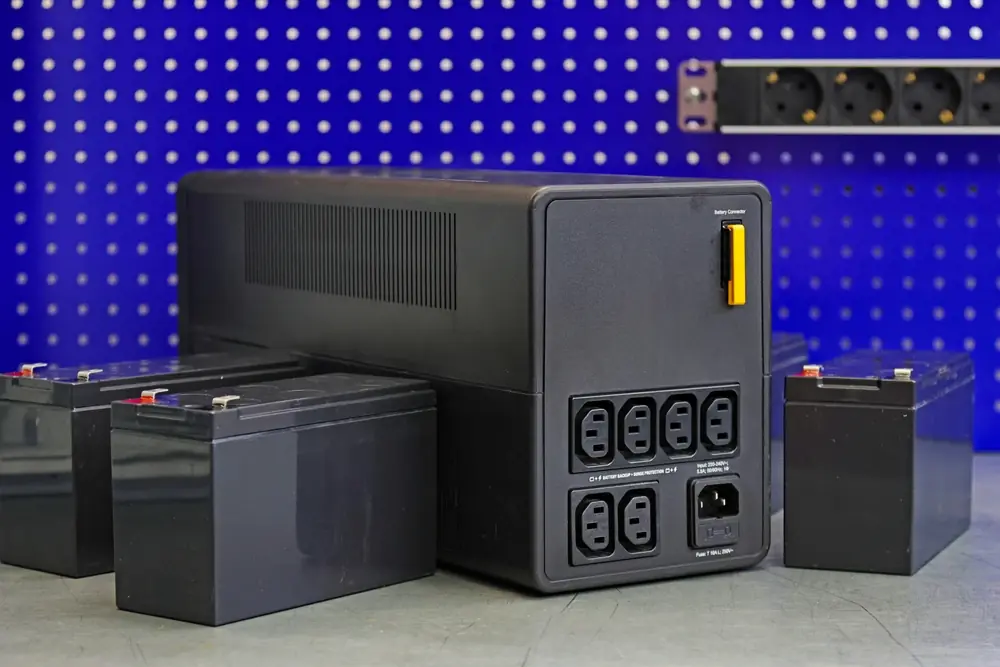
The best UPS for a home server in most UK setups is the CyberPower CP1500EPFCLCD-UK. CyberPower lists pure sine wave output on battery, two UK sockets and four IEC outlets. The model name CP1500EPFCLCD is on the Network UPS Tools (NUT) devices list, so a Linux server can shut down cleanly when the battery runs low.
The APC Back-UPS ES BE850G2-UK is the pick with a full set of UK sockets. For a single Pi or mini PC, the Eaton 3S 550 fits better.
Sources include the NUT hardware compatibility list, the NUT devices dumps library, the NUT usbhid-ups driver page, CyberPower's CP1500EPFCLCD-UK page, Elara.ie's CP1500EPFCLCD-UK specification, Synology's DS224+ specifications, CNX Software's Raspberry Pi 5 power tests, MiniLab HQ's N100 power round-up and Amazon UK listings. We have not tested these UPS units ourselves. Runtime figures are maker or listing claims, named below.
Quick picks
- Best overall: CyberPower CP1500EPFCLCD-UK (1500VA/900W, pure sine wave, 2 UK + 4 IEC)
- Best value with UK sockets: APC Back-UPS ES BE850G2-UK (850VA/520W, 6 battery-backed UK sockets)
- Best for one Pi or mini PC: Eaton 3S 550 (550VA/330W, HID USB)
- Best APC with a screen: APC Back-UPS Pro BR900MI (900VA/540W, LCD, AVR, IEC outlets)
- Keep the router up: a mini DC UPS such as the Yuuki Power 24W unit
We may earn a commission if you buy through links on this page. It never changes our verdicts. How we review.
What size UPS? Watt-sizing table
Start with what your kit draws. Figures are maker specifications and published measurements, not our own.
| Your setup | Typical draw (source) | Plan for | Good fit | NUT driver |
|---|---|---|---|---|
| Raspberry Pi 5 with a USB SSD | 3.0 W idle headless, 8.8 W on a CPU stress test, 16.8 W peak with USB drives busy (CNX Software) | Under 20 W | Eaton 3S 550 | usbhid-ups |
| Intel N100 mini PC | 6 to 12 W idle, 20 to 30 W flat out (MiniLab HQ, citing Notebookcheck and ServeTheHome) | About 30 W | APC BE850G2-UK or BR900MI | usbhid-ups |
| 2-bay NAS (Synology DS224+) | 4.41 W with drives hibernating, 14.69 W during access (Synology) | About 15 W | APC BE850G2-UK, or the NAS's own UPS support | Synology DSM |
| Mini PC + 2-bay NAS + router and switch | About 45 W if you add the mini PC's 30 W upper figure to the DS224+ access figure of 14.69 W, before the network kit's adapter ratings | 50 to 100 W | CyberPower CP1500EPFCLCD-UK | usbhid-ups |
| Router and fibre box only | Read the watts on each power adapter | Within the UPS's DC limit | Mini DC UPS | None (no data link) |
Every mains UPS here has watts to spare for these loads, so choose on runtime and sockets. The plan-for column rounds the published figures. A plug-in power meter gives your own reading.
Spec and Linux table
| Model | VA / watts | Outlets | Battery waveform | NUT compatibility list |
|---|---|---|---|---|
| CyberPower CP1500EPFCLCD-UK | 1500 / 900 | 2 UK + 4 IEC C13 | Pure sine wave (CyberPower) | CP1500EPFCLCD listed (Cyber Power Systems) |
| APC Back-UPS ES BE850G2-UK | 850 / 520 | 6 UK battery + 2 UK surge only | Not stated on the Amazon UK listing | Back-UPS ES 850G2 listed (APC) |
| Eaton 3S 550 (3S550B) | 550 / 330 | 3 UK battery + 3 UK surge only | Not stated on the Amazon UK listing | 3S 550 listed (Eaton); the listing is the Gen2 |
| APC Back-UPS Pro BR900MI | 900 / 540 | 6 IEC | Not stated on the Amazon UK listing | Not named; NUT's usbhid-ups page says it supports some APC models |
| Yuuki Power mini DC UPS (32Wh) | 24 W max output | USB, 12/9/5 V DC barrels, PoE | DC output | No data link |
Sources: NUT devices dumps library (networkupstools.org/ddl, model pages checked 17 November 2026; the NUT user manual dates its current snapshot 14 November 2026), CyberPower's product page, Elara.ie's specification and Amazon UK listings, checked 17 November 2026.
What matters when you choose
Watts, not VA. Boxes lead with VA. Compare the watt rating with what your kit draws.
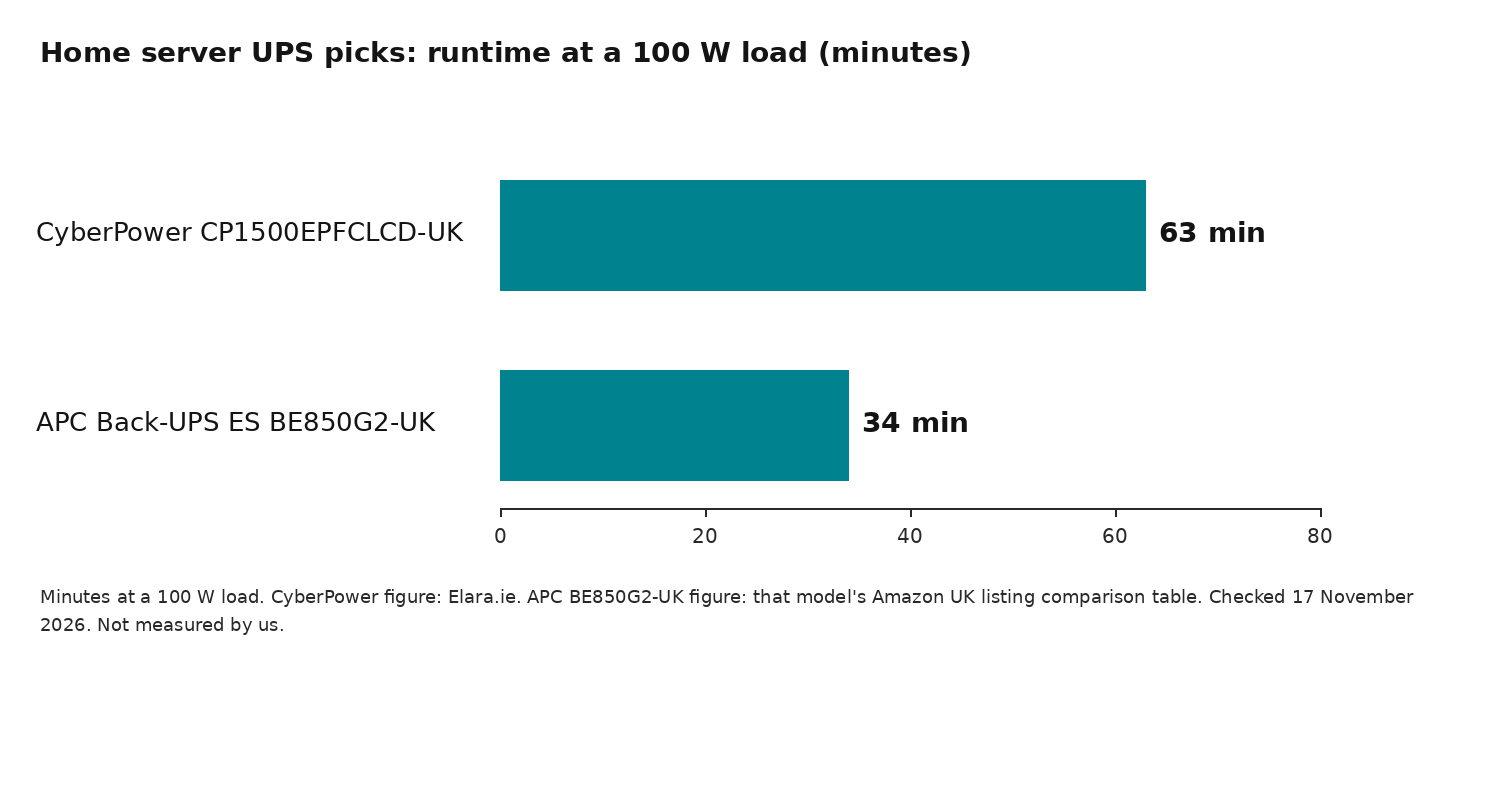
Runtime. A light load runs far longer than the full-load figure suggests. For the CP1500EPFCLCD-UK, the Amazon UK listing's comparison table gives 10 minutes at half load and 3 minutes at full load. CyberPower's product page shows a half-load runtime of 10 minutes. Elara.ie's specification lists those same half-load and full-load figures, plus 63 minutes at 100 W and 120 minutes at 50 W. CyberPower's page does not publish the 50 W and 100 W figures.
Sine wave. CyberPower says its pure sine wave output suits power supplies with active power factor correction (PFC). Pis and mini PCs use external adapters. For an ATX power supply with active PFC, pure sine is the safer choice.
A USB data port. This lets Linux watch the battery and shut down in time. Without it, the server still stops when the battery empties.
UK sockets or IEC. IEC C13 sockets need IEC leads, not a normal UK plug. The APC BE850G2-UK and Eaton 3S 550 have UK sockets. The CyberPower has both.
Replaceable battery. Sealed lead-acid batteries wear out. The APC BE850G2-UK listing's product information gives an average battery life of 3.5 years. CyberPower lists the RBP0016 replacement pack for the CP1500.
The picks
CyberPower CP1500EPFCLCD-UK
CyberPower lists this line-interactive UPS with pure sine wave output, automatic voltage regulation, an LCD and a 4 ms transfer time.
The Amazon UK listing's comparison table gives this model 1500VA/900W, 10 minutes at half load and 3 minutes at full load, and a weight of 11.3 kg. CyberPower's product page agrees on 1500VA and 900W. A separate product-information row on the same Amazon page lists an 8-minute runtime, which does not match that table, so the capacity figures here follow the comparison table and CyberPower's page.
Who it's for: anyone powering a mini PC, NAS and network equipment together, or running a server with an active PFC power supply.
Who it isn't for: someone with just one Pi on a shelf. At 11.3 kg on the listing's comparison table, it is a lot of box for that.
APC Back-UPS ES BE850G2-UK
The BE850G2-UK has eight standard UK sockets. Six have battery backup and surge protection. Two are surge only.
The listing's comparison table gives 520 W, 34 minutes at 100 W and no automatic voltage regulation. Item details give a three-year manufacturer warranty. Product information gives an average battery life of 3.5 years. The same product-information block also lists 800 W and a runtime of 1 hour 5 minutes, which do not match the comparison table, so those two figures are not used here.
Who it's for: Pi, mini PC and NAS owners looking for standard UK sockets and NUT support.
Who it isn't for: homes with regular brownouts. An AVR model rides out dips without using the battery.
Eaton 3S 550
The Eaton 3S 550 is a slim off-line UPS with six UK sockets. Three are battery-backed and three are surge only. Eaton's listing describes it as using off-line technology.
The listing gives 330 W and a standard runtime of 10 minutes. It describes a HID-compliant USB port, and the comparison table says that port integrates with Linux, Windows and macOS. NUT lists a "3S 550" under Eaton. The Amazon listing is the Gen2 (3S550B).
Who it's for: a single Raspberry Pi or mini PC, along with a router.
Who it isn't for: anyone running a NAS and mini PC together who needs a long battery runtime.
APC Back-UPS Pro BR900MI
The BR900MI is a tower UPS with six IEC outlets, an LCD, automatic voltage regulation and dataline protection.
The listing's comparison table gives 540 W and 50 minutes at 100 W. A separate product-information field says 42 minutes and does not name the load, so that second figure is not used here. Unlike the other mains models, it has no entry of its own on the NUT list, so check NUT's driver notes before relying on it for automatic shutdown.
Who it's for: people who already have IEC leads and prefer an APC UPS with a display.
Who it isn't for: anyone needing standard UK sockets without having to buy different leads.
A mini DC UPS for the router
A powered server is little use if the router goes dark. A mini DC UPS keeps the network kit running alongside the main UPS.
This 10,400 mAh (32Wh) unit provides up to 24 W total output through USB, 12, 9 and 5 V DC barrel connections and switchable PoE. The Amazon UK listing's about text says the charger cable is a 1 m UK 3-pin lead. With no data link to the server, it is for network kit only.
Who it's for: keeping a router or fibre box powered alongside a mains UPS.
Who it isn't for: powering the home server itself.
Setup: make Linux shut down on its own
- Connect the UPS's USB data cable to the server and install the
nutpackage on Debian, Ubuntu or Raspberry Pi OS. - Run
nut-scannerto detect the UPS. Open/etc/nut/ups.confand add a section containingdriver = usbhid-upsandport = auto. - Start the driver, then run
upscwith your UPS name to see battery charge, load and status. - Configure
upsmonso the server shuts down when the UPS reports a low battery. - Test by unplugging the UPS from the mains and checking the server shuts down. Repeat yearly as the battery ages. First, make sure your backups restore.
On a Synology NAS, DSM connects directly to a USB UPS and can share its status with other machines as a network UPS server.
Still building? See the Raspberry Pi 5 home server kit, read the mini PC for a home server guide or follow self-hosting: getting started.
FAQ
What size UPS do I need for a home server?
Add up the watts your kit draws. A Pi or mini PC with a NAS usually draws well under 100 W. At that level, runtime and sockets matter more.
Does a UPS work with Linux?
Yes. Network UPS Tools supports compatible units. Check its list for your exact model. The usbhid-ups driver covers many USB units.
What is NUT?
Network UPS Tools is a driver, a server (upsd) and a monitor (upsmon) that together read the UPS and let connected machines shut down safely.
Pure sine wave or simulated?
Pure sine wave is the safer option for power supplies with active PFC. CyberPower says that about the CP1500EPFCLCD-UK.
As an Amazon Associate I earn from qualifying purchases.